
Reference Design · Subwoofer · Dual 18″
Penn Dual-18 Sub
Dual 18″ reflex · Slot-ported
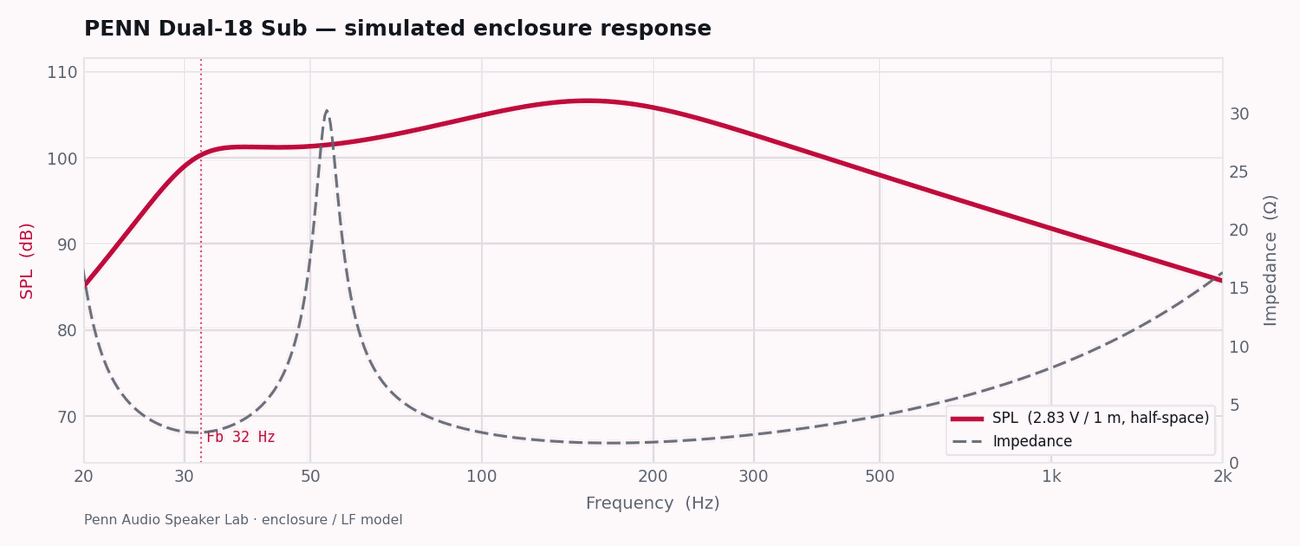
A high-output dual-18 reflex subwoofer for live music and large-room cinema. Two 18″ drivers share a single chamber and a slot port tuned near 32 Hz, coupling into +6 dB of sensitivity and real headroom before the excursion ceiling.
Specifications
Engineered, then verified.
Every figure on this page traces to this cabinet’s design data in the Penn Audio Speaker Lab, where it’s modeled as a complete system and verified before production.
| Configuration | Dual-18 subwoofer, vented bass reflex (shared chamber, slot port) |
|---|---|
| Frequency response (target) | 28 – 100 Hz |
| Cabinet tuning Fb | 32 Hz (slot-tuned; re-tunable to ~25 Hz for cinema) |
| Sensitivity | 103 dB SPL (design target) |
| Maximum SPL | 137 dB (design target, at tuning) |
| Power handling | 3400 W (program, 2.5 Ω) |
| Nominal impedance | 2.5 Ω (two drivers in parallel) |
| LF transducers | 2 × 18″ drivers (parallel) |
| Recommended LP | 80 Hz LR4 (outboard DSP) |
| Enclosure | 13-ply Baltic birch, heavily braced |
| Dimensions (W × H × D) | 960 × 560 × 750 mm |
Inside the design
Why it’s built this way.
Coupled dual-18
Two 18″ drivers side-by-side in one shared chamber radiate coplanar and couple into +6 dB of sensitivity and 6 dB more acoustic output before Xmax — clean to array with other cabinets.
Music-first tuning
A deliberately small box and a ~32 Hz slot tune trade ultimate extension for sensitivity and port output: the punchy, high-headroom response live engineers want. Lengthen the slot and add a low-shelf in DSP for a ~25 Hz cinema alignment.
Braced for scale
At this panel size, heavy internal bracing — horizontal mid-shelf, vertical spine, and front-to-back stiffeners — is mandatory to keep cabinet resonances out of the operating band.
Penn Audio
Hear the Dual-18 Sub on your system.
Book a demo, or download the full datasheet.