
Technology
Engineered, then verified.
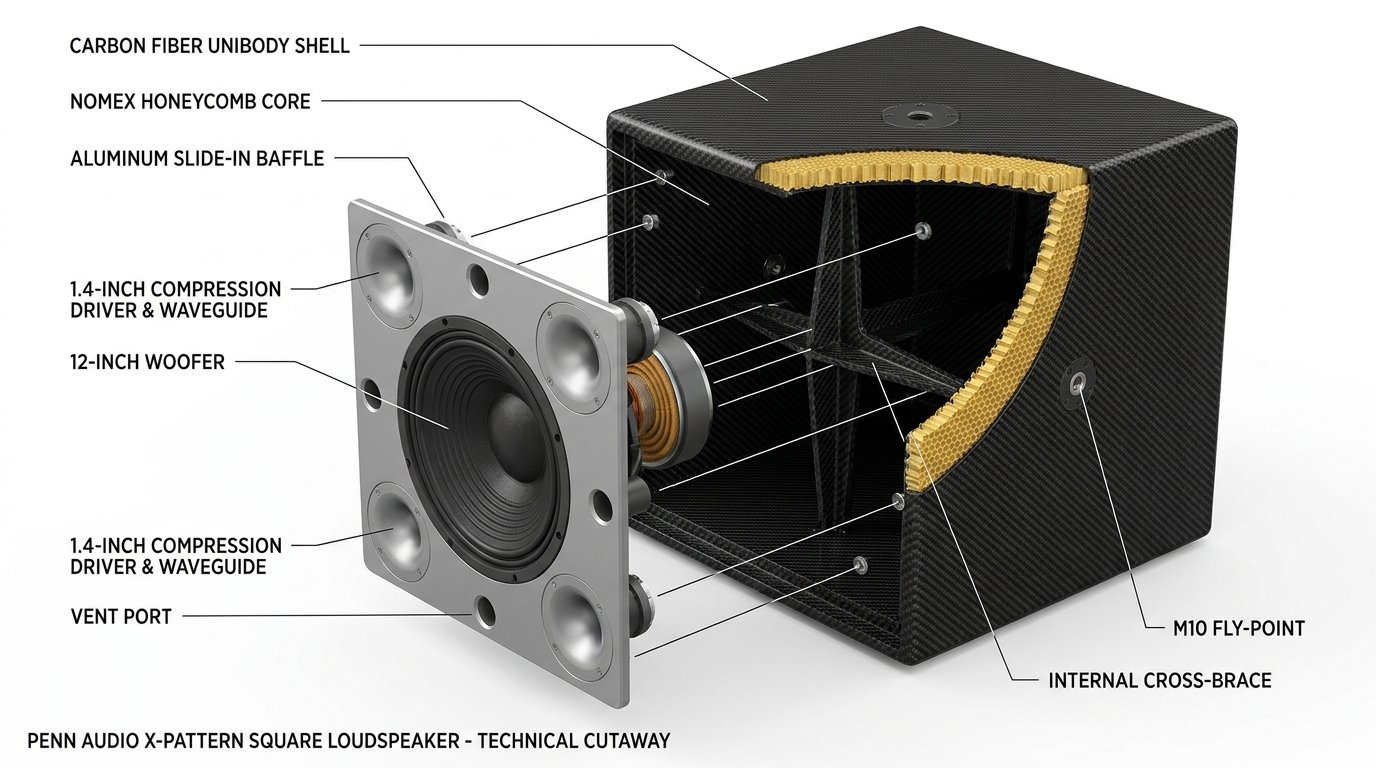
Penn Audio loudspeakers are designed in a physics-accurate simulation platform and built from one continuous piece of carbon fiber. Here’s what’s behind the shell.
Construction
One shell, laid up in an autoclave.
The Unibody is designed around a four-ply T700 carbon-fiber twill skin, oriented ±45° / 0° / 90° / ±45°, with a 10 mm Nomex aramid honeycomb core between the outer skin and a three-ply inner skin. The sandwich is designed to cure in an autoclave, with a co-cured carbon-fiber I-beam brace integrated into the shell.
The design targets a first lateral panel resonance above 420 Hz even on the largest subwoofer — clear of the operating band, so the cabinet adds no coloration of its own. Construction figures reflect the Unibody design intent and may be refined in production.
Slide-in baffle
An 8 mm 6082-T6 aluminum baffle, CNC-machined for each transducer and faced with 4 mm carbon fiber, slides into the front face. A continuous EPDM bulb gasket (35 Shore-A) seals it — rated to 8 kPa, well above any vented alignment in the line.
Rated rigging
Stainless, locking HeliCoil inserts bond into co-cured 6082-T6 load plates on all four faces. Working-load limit 1.6 kN per point, 10× safety factor for overhead suspension per ANSI E1.6-1 and IEC 60598-2-22.
X-pattern array
One woofer centered, four corner compression drivers on a square baffle. 4-fold symmetry gives rotation-invariant coverage; the coherent series-parallel HF array adds +6 dB of gain and 4× the thermal headroom of one driver.
The Penn Audio Speaker Lab
Every cabinet, simulated before it’s cut.
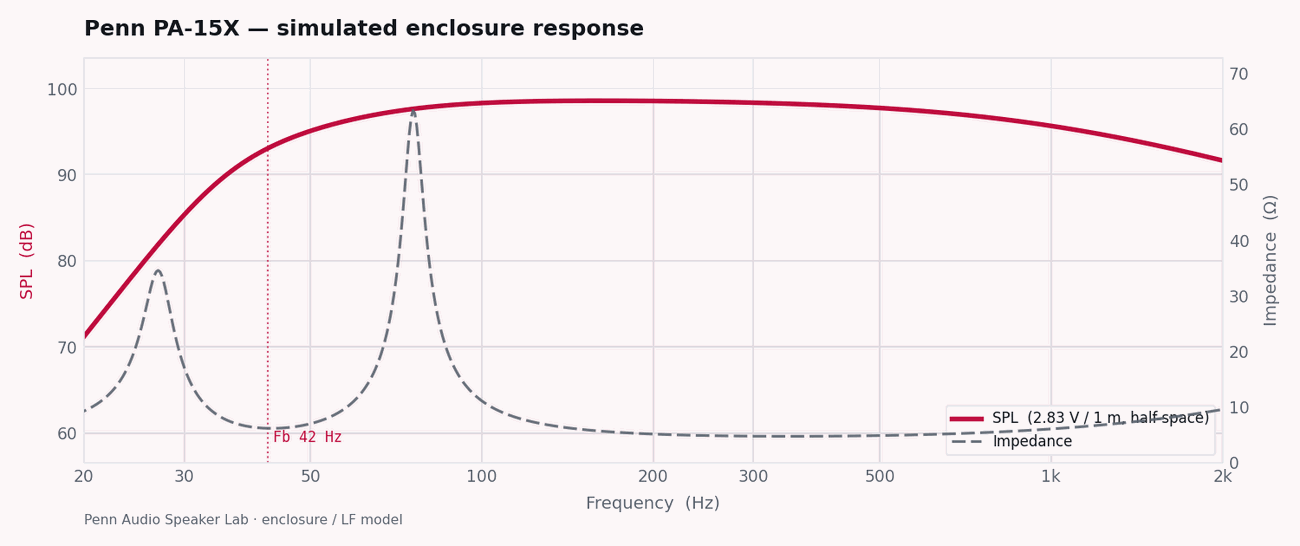
Penn Audio designs and verifies every loudspeaker in an in-house, physics-accurate simulation platform. The workflow runs end to end inside the lab:
Driver modeling
Thiele–Small parameters drive a lumped-element model of each transducer — impedance, excursion, and sensitivity, all from first principles.
Enclosure & port tuning
Sealed and vented alignments are solved against the drivers, with Helmholtz port tuning and end-correction, and a port-velocity check against the chuffing threshold.
Crossover synthesis
Linkwitz–Riley acoustic alignments are synthesized and phase-checked so the sections sum flat through the crossover region.
Panel-resonance analysis
Cabinet wall modes are computed to keep the first panel resonance clear of the operating band.
Matched transducers
One driver set, one voice.
Every transducer across the line is selected and matched in-house — neodymium and ferrite woofers, neodymium bass-mids, and compression drivers. Standardizing on one matched driver set gives a consistent voicing curve and a coherent impedance class from the smallest top to the largest sub.
Open design files
Engineered as a complete model.
Every Penn Audio loudspeaker is developed as a complete .pennspec design in the Speaker Lab — drivers, enclosure, ports, and crossover solved together, then verified and refined before production.
Penn Audio
Engineering you can interrogate.
Ask us anything about the models, the materials, or the methodology. We’ll show our work.